
IMAX (short for Image MAXimum) is a motion picture film format and projection standard created by Canada's IMAX Corporation. The traditional version of IMAX has the capacity to record and display images of far greater size and resolution than conventional film systems. A standard IMAX screen is 22 metres (72 ft) wide and 16.1 metres (53 ft) high, but can vary.
The world's largest cinema screen and IMAX screen is in the LG IMAX theatre in Darling Harbour, Sydney. It is 29.42m (approximately 8 stories) high by 35.73m wide — covering an area of more than 1,015 square metres.
IMAX is the most widely used system for large-format, special-venue film presentations. As of April 2009, there are 320 IMAX theatres in 42 countries, with about half of these located in the United States. About 60% of IMAX venues are commercial theatres with the other 40% being located in educational venues.
Variations of the traditional IMAX format include IMAX Dome (using a tilted dome screen) which is sometimes called OmniMAX, IMAX 3D and IMAX Digital.
IMAX Resolution
IMAX HD (48 fps)
Variations on IMAX included the 48 frames per second IMAX HD process, which sought to reduce strobing and offer a more high definition image by filming and projecting at twice the normal film rate.
Technical specifications
IMAX (15/70)
- spherical lenses
- 70 mm film, 15 perforations per frame
- horizontal pulldown, from right to left (viewed from base side)
- 24 frames per second
- camera aperture: 70.41 mm (2.772″) by 52.63 mm (2.072″)
- projection aperture: at least 20.3 mm (0.80″) less than camera aperture on the vertical axis and at least 0.016″ less on the horizontal axis
- aspect ratio: 1.44:1
History
The desire to increase the visual impact of film has a long history. In 1929, Fox introduced Fox Grandeur, the first 70 mm movie format, but it quickly fell from use. In the 1950s, CinemaScope (introduced in 1953) and VistaVision (1954) widened the image projected from 35 mm film, and there were multi-projector systems such as Cinerama (1952) for even wider presentations. While impressive, Cinerama was difficult to set up, and the seams between adjacent projected images were difficult to hide.
The IMAX system was developed by Graeme Ferguson, Roman Kroitor, Robert Kerr, and William C. Shaw. [2]
During Expo 67 in Montreal, Kroitor's In the Labyrinth, and Ferguson's "Man and The Polar Regions", both used multi-projector, multi-screen systems. Each encountered a number of technical difficulties that led them to design and develop a single-projector/single-camera system based on a technology called "Rolling Loop". Tiger Child, the first IMAX film, was demonstrated at Expo '70 in Osaka, Japan. The first permanent IMAX system was set up in Toronto at Ontario Place in 1971, and is still in operation. During Expo '74 in Spokane, Washington, a very large IMAX screen that measured 90 x 65 ft (27.3 x 19.7 m) was featured in the US Pavilion (the largest structure in the expo). About 5 million visitors viewed the screen, which covered a person's total field of vision when looking directly forward. This easily created a sensation of motion for nearly everyone, and motion sickness in a few viewers. However, it was only a temporary screen for the six-month duration of the Expo. Several years later, a standard size IMAX screen was installed, and is still in operation at the renamed "Riverfront Park IMAX Theatre."
The first permanent IMAX Dome installation, the Reuben H. Fleet Space Theater and Science Center, opened in San Diego's Balboa Park in 1973. The first permanent IMAX 3D theatre was built in Vancouver, British Columbia for Transitions at Expo '86, and was in use until September 30, 2009[3]. It was located at the tip of Canada Place, a Vancouver landmark.
Over the summer of 2006, IMAX's stock fell markedly (by as much as 60%) with the announcement of an SEC investigation[4], falling again when the announced third quarter earnings were behind the previous year's.
Technical aspects


The intent of IMAX is to dramatically increase the resolution of the image by using a much larger film frame. To achieve this, 65 mm film stock is run horizontally through the cameras. While traditional 65 mm film has an image area that is 48.5 mm wide and 22.1 mm tall (for Todd-AO), in IMAX the image is 69.6 mm wide and 48.5 mm tall. In order to expose at standard film speed of 24 frames per second, three times as much film needs to move through the camera each second.[citation needed]
Drawing the large-format film through the projector was a difficult technical problem to solve; conventional 70 mm systems were not steady enough for the 586x magnification. IMAX projection involved a number of innovations. William Shaw of IMAX adapted an Australian patent for film transport called the "rolling loop" by adding a compressed air "puffer" to accelerate the film, and put a cylindrical lens in the projector's "block" for the film to be vacuumed up against during projection (called the "field flattener" because it served to flatten the image field). Because the film actually touches the "field flattener" lens, the lens itself is twice the height of the film and is connected to a pneumatic piston so it can be moved up or down while the projector is running. This way, if a piece of dust comes off the film and sticks to the lens, the projectionist can switch to the clean side of the lens at the push of a button. The lens also has "wiper bars" made of a felt or brush-like material which can wipe the dust off the lens as it moves up or down to keep the show clean. IMAX projectors are pin stabilized, meaning four registration pins engage the sprockets at the corners of the projected frame to ensure perfect alignment. Shaw added cam-controlled arms to decelerate each frame to eliminate the microscopic shaking as the frame "settled" onto the registration pins. The projector's shutter is also open for around 20% longer than in conventional equipment and the light source is brighter. The largest 12–18 kW xenon arc lamps have hollow, water-cooled electrodes. An IMAX projector is therefore a substantial piece of equipment, weighing up to 1.8 tonnes and towering at over 178 centimetres (70 in) tall and 195 centimetres (77 in) long. The xenon lamps are made of a thin layer of quartz crystal, and contain xenon gas at a pressure of about 25 atmospheres (367 PSI); because of this, projectionists are required to wear protective body armor when changing or handling these in case the lamp breaks (e.g., due to a drop to the floor) because the flying shards of crystal could be deadly when combined with the high pressure of the gas within.[citation needed]
IMAX uses a stronger "ESTAR" (Kodak's trade name for PET film) base. The reason is not for strength, but precision. Developing chemicals do not change the size or shape of Estar, and IMAX's pin registration (especially the cam mechanism) is intolerant of either sprocket-hole or film-thickness variations. The IMAX format is generically called "15/70" film, the name referring to the 15 sprocket holes per frame of 70 mm stock. The bulk of the film requires large platters rather than conventional film reels.[citation needed]
In order to use more of the image area, IMAX film does not include an embedded soundtrack. Instead, the IMAX system specifies a separate six-channel 35 mm magnetic film synchronized to the film. (This original "mag-stripe" system was commonly used to "dub" or insert studio sound into the mixed soundtrack of conventional films.) By the early 1990s, a separate digital 6-track source was synchronized using a more precise pulse generator as a source for a conventional SMPTE time code synchronization system. This development presaged conventional software. The software works in a similar style as the DDP except that instead of the audio file being based on discs, it is instead played directly off a hard drive in the form of a single uncompressed audio file containing the 6 channels which are distributed directly to the amplifiers rather than using a decoding method such as Dolby Digital. Many IMAX theaters place speakers directly behind the screen, as well as distributing the speakers around the theater to create a three-dimensional effect.[citation needed]
IMAX theater construction also differs significantly from conventional theaters. The increased resolution allows the audience to be much closer to the screen; typically all rows are within one screen height. (Conventional theaters seating runs 8 to 12 screen heights) Also, the rows of seats are set at a steep angle (up to 23 degrees in some domed theaters) so that the audience is facing the screen directly.[citation needed]
IMAX 3D
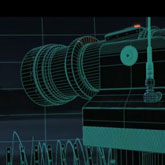
To create the illusion of three-dimensional depth, the IMAX 3D process uses two camera lenses to represent the left and right eyes. The two lenses are separated by an interocular distance of 64 mm (2.5"), the average distance between a human's eyes. By recording on two separate rolls of film for the left and right eyes, and then projecting them simultaneously, viewers can be tricked into seeing a 3D image on a 2D screen. The IMAX 3D camera is cumbersome, weighing over 113 kg/250lbs. This makes it difficult to film on-location documentaries.
There are two methods to creating the 3D illusion in the theatre. The first involves polarization. During projection, the left and right eye images are polarized perpendicular to one another (or right-hand and left-hand circular polarization is used) as they are projected onto the IMAX screen. By wearing special eyeglasses with lenses polarized in their respective directions to match the projection, the left eye image can be viewed only by the left eye since the polarization of the left lens will cancel out that of the right eye projection, and the right eye image can be viewed only by the right eye since the polarization of the right lens will cancel out that of the left eye projection. Another method for 3D projection involves LCD shutter glasses. These glasses contain LCD panels which are synchronised to the projector which alternates rapidly at 96 frames per second between displaying the left and right images which are momentarily viewed by the appropriate eye by allowing that eye's panel to become transparent while the other remains opaque. While the panels within these active-shutter 3D glasses alternate at 96 frames per second, the actual film is displayed at 24 frames per second.
Several films produced in the RealD 3D process for release in conventional theaters have also been presented in IMAX 3D, including Dreamworks' Monsters vs Aliens, Columbia Pictures' The Little Engine That Could and U2 3D.



















 Colors of a complementary relationship assigned equal proportion.
 Colors reassigned with proportions allocated to dominant and subdominant areas.
 Color intensity and proportion modified. Using tints and shades of the original colors results in a moderate level of contrast and medium value.
 Colors applied to composition.
 Color intensity and proportion modified - the whole area displays a moderately-high contrast and medium value.
 Colors applied to composition.
 Colors of a triad relationship assigned equal proportion.
 Colors reassigned with proportions allocated to dominant, subdominant, and accent areas.
 Color intensity and saturation modified - the whole area displays a moderately-high contrast level.
 Colors applied to composition.
 Color intensity and saturation modified - the whole area displays a moderately low contrast level.
 Colors applied to composition.
 Color intensity and saturation modified - the whole area displays a medium/dark value.
 Colors applied to composition.
 Color intensity and saturation modified - the whole area displays a light value,
 Colors applied to composition.